
Why You Should Never Use Your Regular Email for Marketing Emails
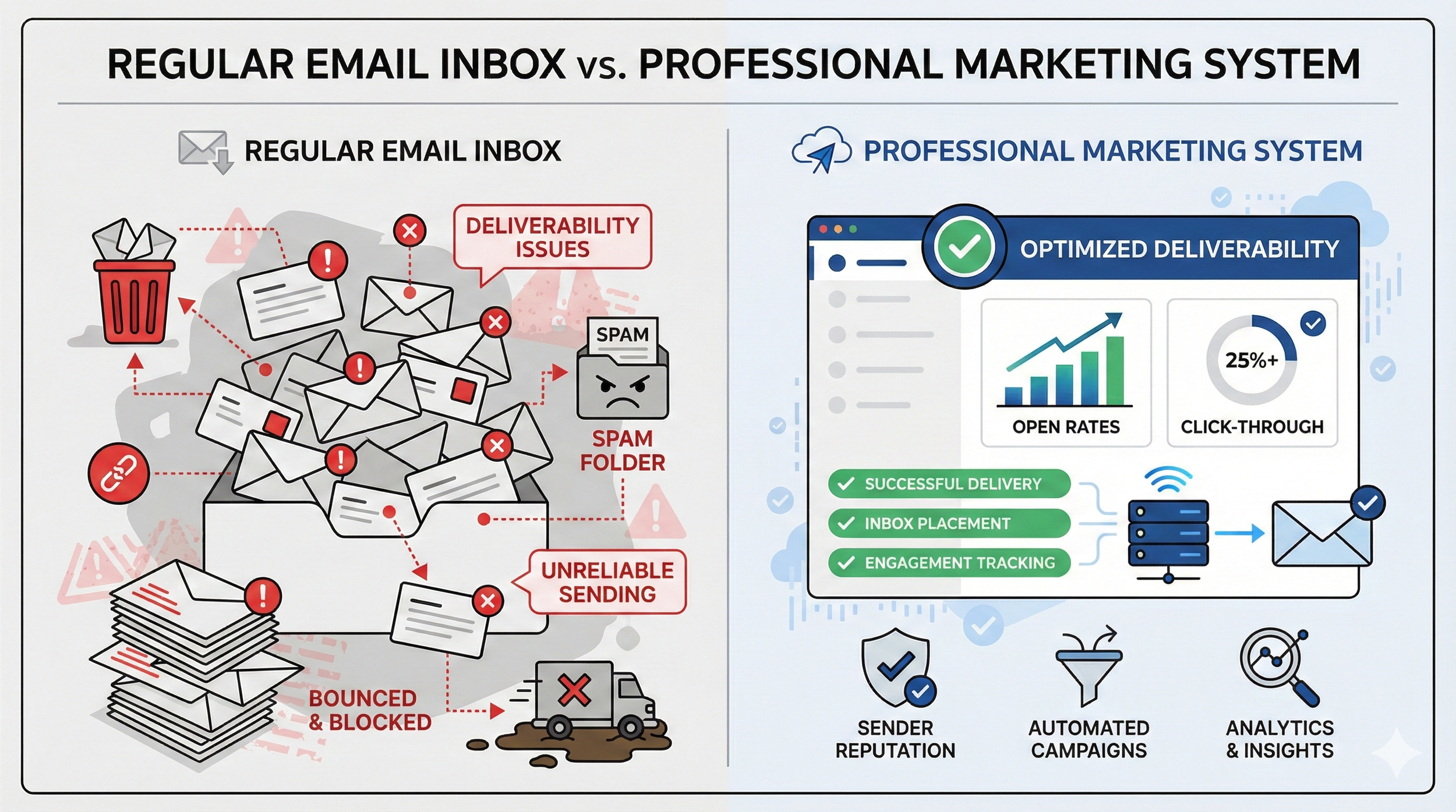
Most small businesses start out sending emails from their regular inbox. It’s simple, familiar, and already sitting on your computer or phone. But as soon as you begin sending email to groups of contacts, your regular email account becomes one of the riskiest and least effective places to send from.
There is a big difference between everyday email and marketing email. Marketing email requires different tools, safeguards, and deliverability processes. Using your normal inbox can quietly hurt your results without you even knowing why.
Here’s what you need to understand before you send another “email blast” from Gmail, Outlook, or any personal email client.
1. Your Regular Email Inbox Was Never Built for Marketing Volume
Email providers like Gmail and Outlook are designed for one-to-one communication. They expect normal human sending patterns: small batches, personal conversations, and low daily volume.
When you suddenly send to 200, 500, or thousands of contacts, your provider sees that as unusual or even suspicious. That’s when things can go wrong:
Emails land in spam
Your account gets rate-limited
Messages stop sending
In some cases, your account can be temporarily restricted
Marketing platforms are built for safe, high-volume sending. They pace messages, manage volume, and use specialized infrastructure to avoid spam triggers.
2. Compliance Becomes Your Responsibility
Email laws require senders to:
Include an unsubscribe link
Track and honor opt-outs
Manage spam complaints
Use permission-based lists
Follow regional regulations
Your regular email account does none of this for you.
That means you must manually manage unsubscribes, suppress contacts, and ensure you’re following every rule. One mistake can lead to:
Spam complaints
Account problems
Legal issues
Long-term deliverability damage
A proper email marketing platform handles compliance automatically so you don’t have to.
3. You Get No Analytics — So You’re Flying Blind
When you send a marketing message from your inbox, you have no idea:
Who opened it
Who clicked
Who bounced
Who marked it as spam
Who should be followed up with
Without insight, you can’t improve your message, timing, or audience.
Email marketing systems give you the analytics you need to understand what’s working — and what’s not.
4. Your Inbox Cannot Scale With You
Sending 50 emails from Gmail might work.
Sending 500 gets risky.
Sending 5,000 is almost guaranteed to cause problems.
As your list grows, your ability to reach people shrinks if you rely on a normal inbox. Providers simply were not designed for large-scale marketing sends and may block or throttle you to protect their systems.
Email marketing tools, on the other hand, are built for scale and maintain reliable delivery even at high volumes.
5. If Something Goes Wrong, There’s No One to Call
When you send marketing emails through your personal or business inbox and something breaks — low open rates, spam filtering, bounce spikes, or error messages — you’re on your own.
Gmail, Outlook, and most email providers do not offer support for marketing deliverability issues. Their tools aren’t designed to diagnose campaign performance or troubleshoot inbox placement.
With AllClients, you’re not alone.
Our Managed Email support helps you understand issues, improve your emails, and keep your deliverability healthy. You also have access to an Email Scoring System that evaluates your message and gives guidance to help increase the chances of inbox placement before you hit send.
That kind of help simply doesn’t exist when using your personal inbox.
6. Marketing Email Requires Infrastructure Your Inbox Doesn’t Have
Successful email marketing relies on far more than just “sending an email.” Behind the scenes, a dedicated marketing platform is managing:
Delivery optimization
ISP throttling
Bounce processing
Spam feedback loops
List hygiene
Suppression management
Deliverability monitoring
Your inbox was never designed to handle any of this. When you use it for marketing, you miss out on the protections and optimizations that keep your emails from getting flagged.
7. Mixing Personal and Marketing Email Hurts Everything
If your marketing sends cause problems — like spam complaints or sending pattern spikes — the consequences don’t stay isolated.
It can hurt:
Your personal emails
Your one-to-one client communication
Your transactional messages
Your day-to-day business operations
Poor sending behavior from your inbox affects your entire domain, not just your marketing messages.
Keeping marketing email separate from personal email is essential for long-term deliverability.
8. Your Domain Reputation Can Be Damaged Quickly
Your domain reputation is basically your email “credit score.” It determines whether mailbox providers trust your messages or send them straight to spam.
Using your regular inbox for marketing can damage that reputation quickly because:
High-volume sends look suspicious
Bounces and complaints are not managed
Sending patterns are inconsistent
There’s no warm-up or throttling
Marketing content is mixed with personal traffic
Once your domain reputation drops, everything you send — even your personal emails — can suffer.
A proper email marketing system protects your domain reputation with authentication, pacing, compliance tools, and professional deliverability infrastructure.
The Bottom Line
Your regular email account is perfect for personal and one-to-one communication.
It is not built for marketing.
A true email marketing platform:
Improves deliverability
Protects your domain reputation
Keeps you compliant
Provides analytics
Scales safely
Separates personal and marketing email
Gives you real support when you need it
Helps you improve your messages before sending
If you want your marketing emails to reach the inbox, stay compliant, and grow your business, your everyday inbox isn’t the right tool for the job.
A dedicated email marketing system is.
